Caryl Churchill’s landmark play Cloud 9 has a special place in my heart. First performed in 1979, I had the great privilege of directing a student production of it while I was at Manchester University in 1981 as part of Manchester Umbrella Theatre Company’s offering to the Edinburgh Festival that summer 45 long years ago. I remember it as a very happy production and one of which I was very proud… perhaps the first time I really got to grips with a mature sense of what it meant to be a theatre director (even though I’d already directed a fair bit by then). And of course it was about sex and gender and there’s hardly anything a 21 year old likes to wang on about more than that.
I haven’t seen or read the play since.
The poster for Dominic Cooke’s 2026 revival of Caryl Churchill’s landmark play
So it was that I found myself feeling both nervous and emotional about watching a preview of the National Theatre’s latest revival of Cloud 9 last Friday night. Aside from all the youthful memories it was triggering, I had an uneasy feeling that it might just be a bit crap. Not the production… but it was very much a play of its time, and nothing dates like yesterday’s contemporary and biting relevance.
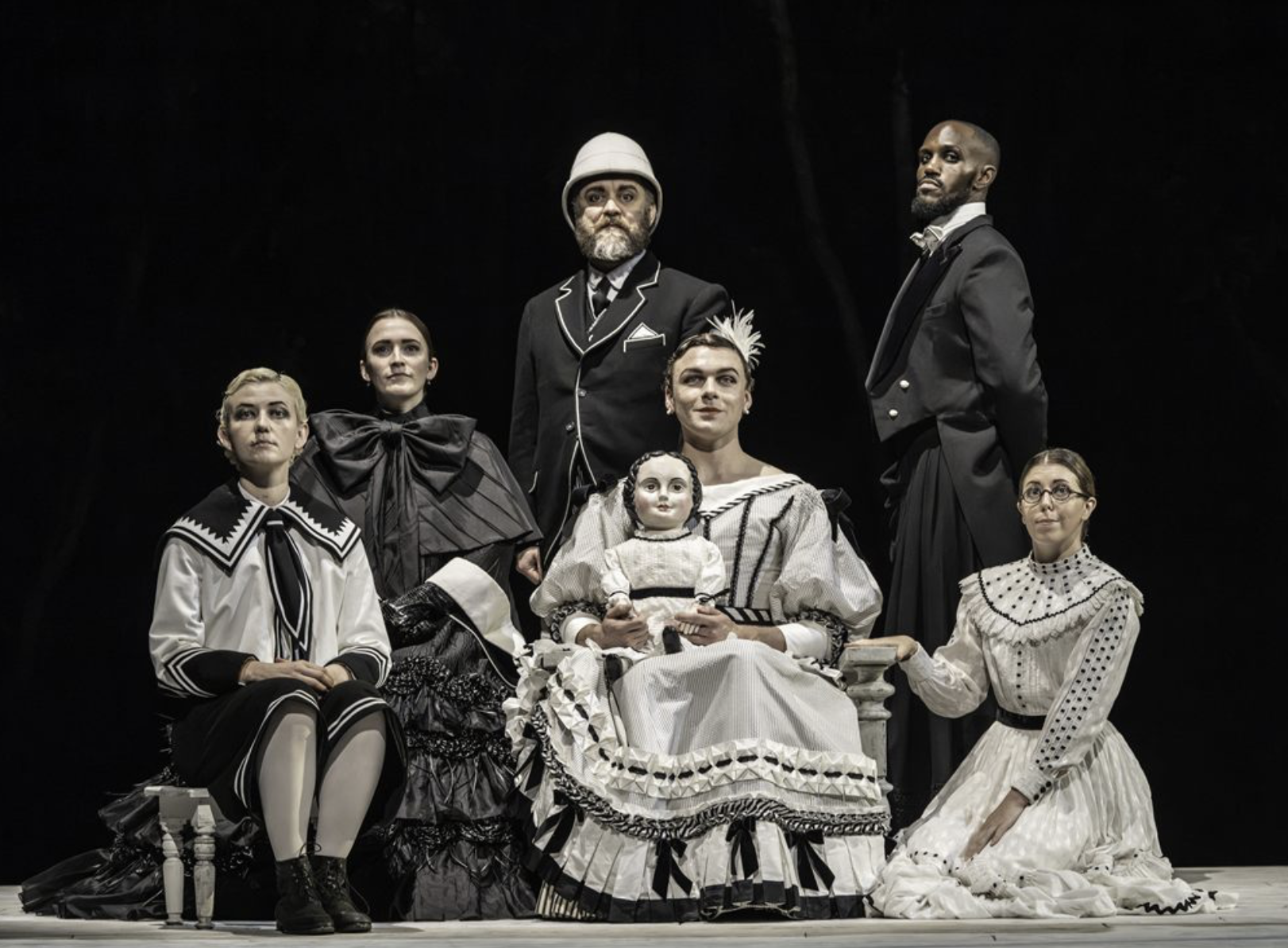
Well, on the plus side it is undeniably a hugely enjoyable evening and the NT cast, including Sam Troughton and Charlotte Ritchie as its best known members, are clearly having a great time too. There are some nice design ideas which I won’t spoil here – and a clear thesis is laid out by director Dominic Cooke. Without going into too much detail I thought the second half, set in 1979 (but with the characters ingeniously having only aged 25 years) was the more successful of the two. I struggled a bit with the first act set a hundred years earlier in Victorian Colonial Africa. Cooke has gone for a pantomime style of posed, monochrome, ‘out-front’ Victorian melodramatic farce. The first half of Cloud 9 IS farce-like – that’s beyond dispute – but my (admittedly distant) memory of directing it is that there is truth and humanity to be found there too. Indeed, if you eschew any attempt to find the truth of the character’s inner humanity then as a satire on repressed and hypocritical sexuality it doesn’t actually make sense. If a character is repressed you have to know what it is they are repressing. For me there’s a vital layer missing in Act 1 of this production – but having said that, it’s an enjoyable romp that had the audience pissing themselves with laughter. I didn’t have any such quibbles with the ‘modern’ second act, which was nicely played all round.
The Act 1 Staging of the NT Revival of Cloud 9. Photograph by Johan Persson.
But has it dated?
Ehm… well… yes and no.
If I sound ambivalent it’s because perhaps it reads differently for someone of my age. It was certainly a ground breaking play of its time (the late 1970s/early 1980s) but those of us working in Theatre in Education, Community Theatre, Agit Prop etc spent an awful lot of those decades taking the piss out of Victorian (sexual) hypocrisy… and talking about our genitalia. So perhaps Act 1 will feel fresh to younger generations (i.e. anyone under 55) in a way it doesn’t to me. Act 2 – set in 1979 – prompts a whole other discussion.
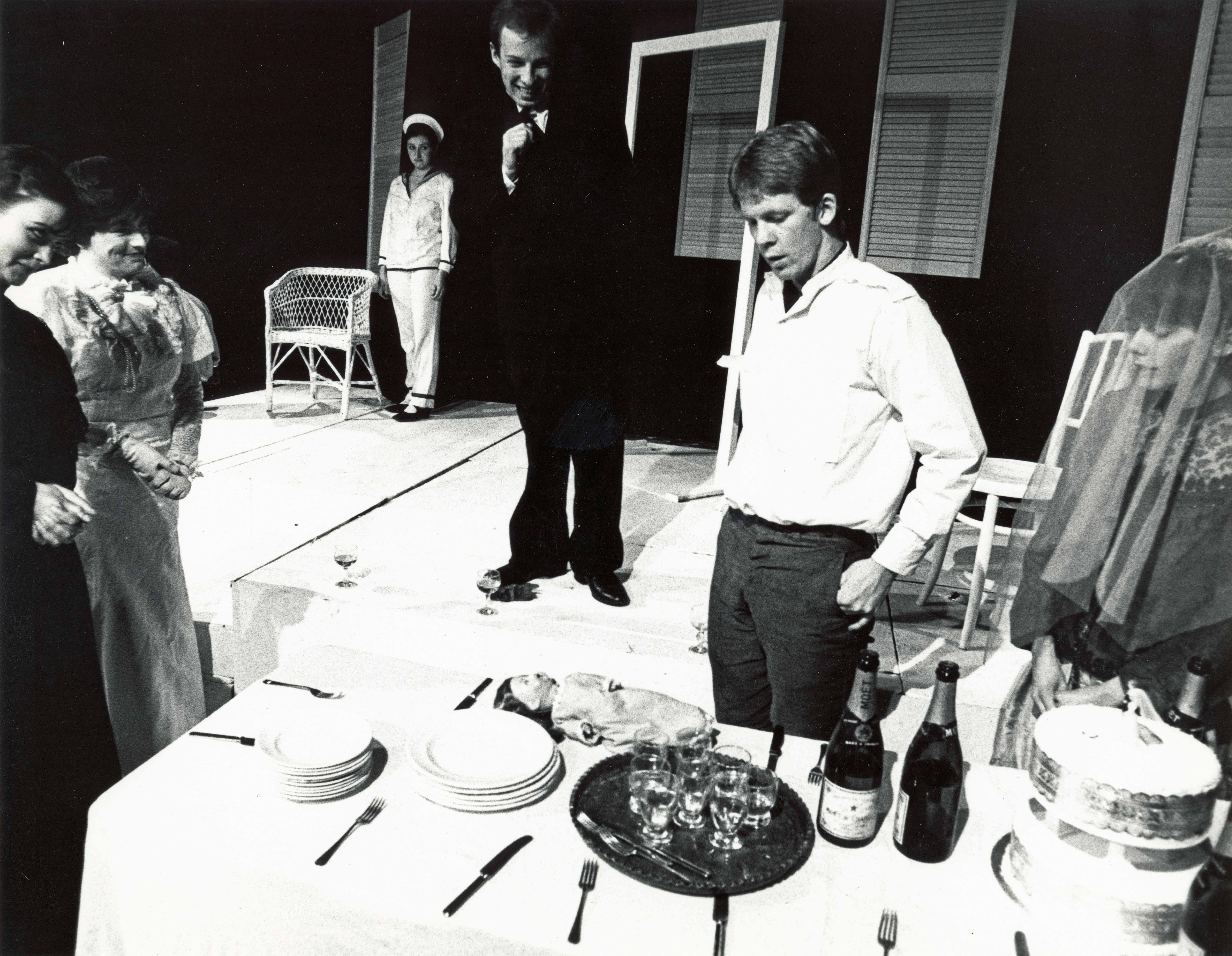
My 1981 student production of Cloud 9 featuring members of Manchester Umbrella Theatre Company
In 1979 – and even in 1981! – 1979 was NOW. In 2026 1979 is most definitely THEN. It is almost as much of a past era as the Victorian age was to the play’s original audiences. The sexual and gender landscapes have changed almost as much. I’ve lost count of which wave of feminism we’re on but I think we’ve moved on at least two. The gay male community has had to contend with the HIV/AIDS epidemic, and AIDS has also had a dramatic impact on sexuality in parts of the same Africa depicted in Act 1. Gay men now have PrEP, and also gay marriage with sexual and cultural implications from both. We have the internet. We have Incels. We have the toxic masculinity of Andrew Tate. We have #MeToo. We have a fiery dialectic between the trans lobby and many lesbians and older feminists. We have Cancel Culture. The characters of Caryl Churchill’s Act 2 aren’t in any way prepared for what is about to hit them.
So, yes, it is dated, not least because in 2026 no writer would include a scene where a prepubescent child sexually propositions an older man. Interestingly, that element of the script survives in the NT revival, however another facet of the original production, not so much. Back in 1979 the part of Joshua, the black African manservant of Act 1, was played by white actor, Tony Rohr. In Caryl Churchill’s foreword to the 1981 published script she writes: ‘There were no black members of the company and this led me to the idea of Joshuabeing so alienated from himself and so much aspiring to be what white men want him to be that he is played by a white.’ This is an eye-widening sentence for modern readers, arguing progressive political purpose for blackface/racial appropriation because of Joint Stock’s lack of diversity. At which point, I have to confess to being convinced by the argument myself as a 21-year-old. This sort of reasoning was de rigueur in ‘progressive’ circles as much as conservative ones. The past really is another country. They do things differently there and I’m not planning a trip back any time soon. So, in the NT revival, the part of Joshua is played by Eloka Ivo. It would be impossible to do otherwise in 2026, but interestingly that leads to a mismatch in Act 2 when the same actor plays Gerry, Edward’s gay lover, and it feels odd for him not to make any mention of what it was to be black and gay in 1979. It’s hard to imagine that writer of Churchill’s astuteness wouldn’t have written the part differently for an actor of colour. The hierarchy of what is perceived acceptable or otherwise to modern audiences tells a story in itself.
Aside from that, more broadly, what made the Cloud 9 so contemporary in 1979 has now rendered it an incongruously nostalgic (albeit hugely enjoyable) period piece… which is what leaves me craving for Churchill to pick up her quill and give us a new Act 3, set perhaps fifty years later in 2029 but with the characters having aged just ten more years. Cathy, Act 2’s vaguely terrifying 4-year-old, would grow into a 21st century internet-traumatised teen, contemplating gender reassignment, throwing a massive cat amongst Victoria, Lin and Edward’s sexual-cultural pigeons. The faux ‘new man’ Martin has remarried and has a teenage stepson up to his smartphone eyeballs in pornography and online toxic masculinity. Betty is getting arrested at Palestine Action demos.
Of course, it’ll never happen (and before anyone starts, yes, yes, I know it’s not for some 60-something bloke to tell Caryl Churchill what to write!) but there’s a good deal of fun to be had riffing on the numerous possibilities, not least as a salutary reminder that 1979 isn’t just another country, it sometimes feels like another planet.
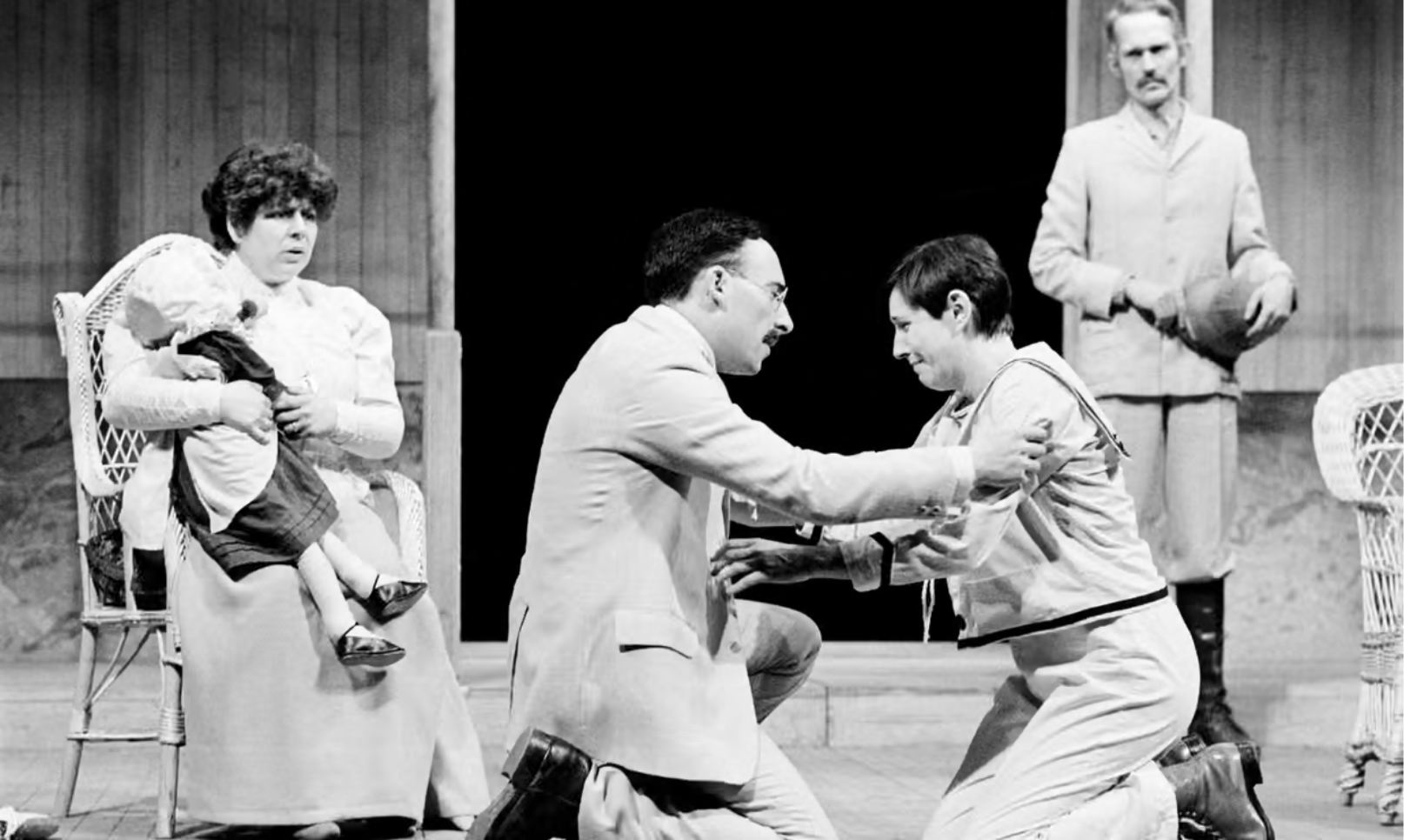
Miriam Margolyes, Antony Sher, Julie Covington and William Hoyland in Cloud 9 at the Royal Court, London, in 1979. Photograph: Donald Cooper
A few weeks ago I booked to see a preview of Shed: Exploded View at Manchester’s renowned Royal Exchange Theatre.
I’d overcome my reservations about the somewhat off-putting promotional graphic, because Phoebe Eclair-Powell’s new play had won the prestigious 2019 Bruntwood Prize for Playwriting and as a fellow scribe, and sometime producer, it’s professionally important for me to keep up with new work and emerging talent.
The day before the show, however, I received an email telling me that the play was one hour and forty minutes long – without an interval. This immediately filled me with anxiety. I am a survivor of Prostate Cancer – the single most common cancer in men in the UK today – and, as is well known, one of the long term side effects of treatment can be certain issues with bladder control. I’m one of the lucky ones, and by no means incontinent, but after about 75 minutes or so I’m going to need the toilet. Of course you don’t have to have cancer to worry about your bladder. According to the House of Commons Library, about 14 million people in the UK are affected by some degree of incontinence, and I’m not sure I’d even fit into that demographic, so in reality the number of people who would view this running time with concern could well be much greater. Lots of men have benign but enlarged prostates. Needing frequent access to a loo is an extremely common issue for older woman – not to mention anyone in the third trimester of pregnancy. In fact, it’s perfectly normal for anyone to need the loo after an hour and a quarter or so, especially if you’ve had a drink before the show (which theatres encourage you to do).
But the running time of Shed: Exploded View is nearly half-an-hour past my Bladder Klaxon, so when I say the prospect of one hour and forty minutes without an interval made me anxious – it’s not some trivial thing. Perhaps I should rephrase – it filled me with dread.
The friend I was coming with had to bail at the last minute (for other, non bladder-related reasons) but I struggled to find someone to pick up the ticket, and the reason two of them gave was that they simply couldn’t risk sitting through a show that long. Others said they might make it through, but they knew that they would spend the last half-an-hour struggling to concentrate, and therefore were unlikely to enjoy the show.
I posted my dismay on Facebook and was astonished by the chorus of agreement that came back, from people of all ages, including a young friend in the 27th week of pregnancy who had passed up on an offer of a ticket to see the Exchange show precisely for this reason.
A highly respected writer and director (over ten years younger than me I should add) posted the following, confirming how easy it is to solve this problem:
‘It’s a huge issue. [My last play] was one act, with no interval initially, and I found that 72 minutes was the official cut off time – we were guaranteed walk outs to the loo (annoying, as the show was 76 minutes). Luckily I was allowed to rewrite it as a two act play with an interval and the theatre made money; the audiences were happy; and the flow of the play worked so much better.I don’t think I’ll be visiting Shed unless I hear great reviews and sit at the end of a row.’
It’s not just Manchester’s Royal Exchange. A friend described an embarrassing incident at The Cursed Child in London, which apparently has a long act. They managed to get out of a tightly packed row, but then they felt too self conscious to return to the auditorium, missing the rest of the performance. This person has also vowed to eschew such long productions unless they can sit at the end of a row as well. We’re going to need a lot of rows.
And spare a thought for the poor actors. Another friend of mine was in a play at the Bristol Old Vic a few years back. He was on stage for the best part of ninety minutes without a break, and it was a challenge for him too.
The fear of urinating uncontrollably is a visceral one – with the prospect of terrible humiliation.
But at the same time, more and more shows run without intervals often far exceeding 90 minutes at a stretch. Personally I’d put a limit of 75 minutes on any single act. I would contend (and it would be interesting to do the research) that the number of people for whom this is an issue far exceeds the numbers of hearing impaired, visually impaired or neurologically divergent in any given audience – because of course bladder issues can and do affect anyone in any demographic.
In terms of accessibility, if I am blind or deaf or autistic or have mobility issues, a theatre will care for me – but if I’m an older man who has had cancer, I simply don’t matter.
A few years ago I was excited to see Circle Mirror Transformation at Home – another of Manchester’s theatres – where I was told by the usher on the way in, that the show was 1 hour 45 Minutes, but if I left for the toilet midway I would not be readmitted. I questioned whether that was even legal. The reason the theatre gave me for this stipulation was as follows:
‘The request […] was made by the actors who found it disruptive when patrons walked down the aisle to look for their seats.’
Well… as long as they get their priorities right. Perhaps the audience should just stay at home so the actors can concentrate.
There was later a concession that I should have been allowed back in, but would have had to watch the rest of the show from a row of seats reserved for toilet sinners right at the back – basically a sort of pant-wetters naughty-step. The ticket had been a birthday treat so I was in the most expensive seats with my wife, which I would lose access to because the show was too long for a normal human bladder. Seriously? As a footnote to that story, by way of apology, the theatre offered me complimentary tickets for their upcoming production of… (wait for it) … Long Day’s Journey Into Night – a play that famously runs for well over three hours. I kid you not.
(Note to reader – I’m about half way, if you need to pop out for a second.)
This trend in theatre for long single acts is – and I choose this word carefully – discriminatory. It discriminates against me, and anybody from the millions-strong cohort of those with similar issues. I wonder if earnest theatre makers believe it to be a trivial side-issue, perhaps even amusing. Yes, we make jokes about it, but that’s precisely because it’s frightening and humiliating. I know that many people are simply too embarrassed even to talk about it, let alone complain. They’d rather stay at home.
I’ve heard creatives argue: ‘We can’t possibly have an interval! It’ll destroy the atmosphere! It’ll break the flow!’ Well there’s nothing more distracting than a dozen people going to the toilet, even if you’re not personally worrying about your own bladder. Oh yes, and please don’t say ‘FLOW’!!!
It is often argued that films are regularly two hours plus in length, so what’s the problem? Well in a cinema it’s easy to pop out to the loo. Cinemas are loud and spacious. You’re not going to disturb anyone. There’s even an app called RunPee for this very purpose.
At the Royal Exchange, the seats are so tightly packed you fear for a DVT at the best of times. Your cramped knees are pressing on your bladder which exacerbates things – and on Tuesday night, I was wedged into the middle of a row. It was impossible to ask everyone to stand up for me without causing a major disruption. In a modern multiplex you are in a much more relaxed position so I can last a lot longer. At least a dozen people went to the toilet during Shed: Exploded Bladder, but they were all seated at the ends of rows. There was quite a sprint for the gents after the curtain-call for the rest of us! But even if a theatre makes it possible for people to come and go, I’ve paid to see the whole play. Why should I have to miss any of it because the theatre hasn’t had the consideration for its audience to provide an interval or wee break?
There are other issues too. I read, almost weekly, about the plight of theatres in these cash strapped times. But it’s hard to be sympathetic when, by insisting on not having an interval, surely the theatre loses a major revenue stream. This is a self-inflicted financial wound. Is the director’s and writer’s desire to have their play performed uninterrupted more important than the financial well-being of the theatre?
There are artistic implications as well. If I’m writing for itv, there will be ad breaks and I have to make sure that the audience is going to stick around. Even on the BBC, the episodic structure means I have to make the end of each tightly time-limited hour of drama compelling, so the audience will come back for more. In theatre, the act structure has a similar function. Last year I went to see Standing at the Sky’s Edge at the Sheffield Crucible. This was a wonderful show, the first act ended with a bang, and going to the bar (and having a wee!!!!) half way through just added to the excitement. Everyone was buzzing. When the second half started, the audience had gained in confidence and the atmosphere had ramped up several degrees. It was an unforgettable experience. I think this is a really good discipline for writers. Shed: Exploded View has many merits, but if you’re busting for a wee, it is doomed to feel overlong and full of unnecessary repetition, even when that repetition is an important stylistic device. Without a time limit the writer loses their sense of discipline.
Writers and directors (and I’ve done both jobs) need to get tattoos to remind themselves that the audience is more important than their play. Their play has to earn our attention, not keep us prisoner against our will. Going to the theatre is pricey, so people need a good reason to commit the time and considerable expense. Writers and directors need to put themselves in the shoes of their audiences, who will constantly be asking themselves whether trekking out to the theatre was worth the effort and, in this case, discomfort.
Of course, one of the big reasons we fork out the big bucks, is for the communal experience of simply being in a theatre. Standing at the Sky’s Edge was the model of this – where the interval allowed people to chat and share their feelings… it’s a social activity even when the subject matter is as serious as Shed. Without an interval, you’re scared to have a drink beforehand, you rush to the loo when it finishes, and then you bugger off to a pub where the drinks are cheaper. No wonder people would prefer to sit at home and watch Netflix.
Back to Tuesday night. I went to find the Front of House Manager. He was very, very sweet. I sensed from the weary look in his eye that he was only too aware of the problem. He advised me to put my feelings in writing and email the theatre management. Last night I got a reply, from someone called the ‘Audience Director’. Again, I kid you not. I clearly need to do what I’m told in future! She replied thus:
‘I would encourage anyone with non-visible access requirements to fill in the form on the access pages of our website, this will automatically tag your account with the relevant information and the Front of House team will be able to help.Alternatively, please do flag any concerns upon arrival to a member of our Visitor Experience staff, as we will do everything we can to accommodate any particular access requirements.’
‘Visitor Experience Staff’???
Hmmmm. Does that make me a ‘Creative Pen Operative’?
Anyway, I had talked to the nice Visitor Experience man and he told me to write the email, so I think we’re going round in circles here. Although I suppose he could have fitted me with a catheter.
But, good boy that I am – I was being ‘directed’ by the Audience Director after all – I had a look at the ‘Access Page’ where presumably I was to register the personal details of my Wracked Bladder, for future reference. The only vaguely relevant option was to ask for end-of-row seats, but as I’ve outlined above, that still discriminates against me because I miss part of the play and in an intimate theatre-in-the-round, like the Exchange, I’m still exposed as a theatrical bed-wetter.
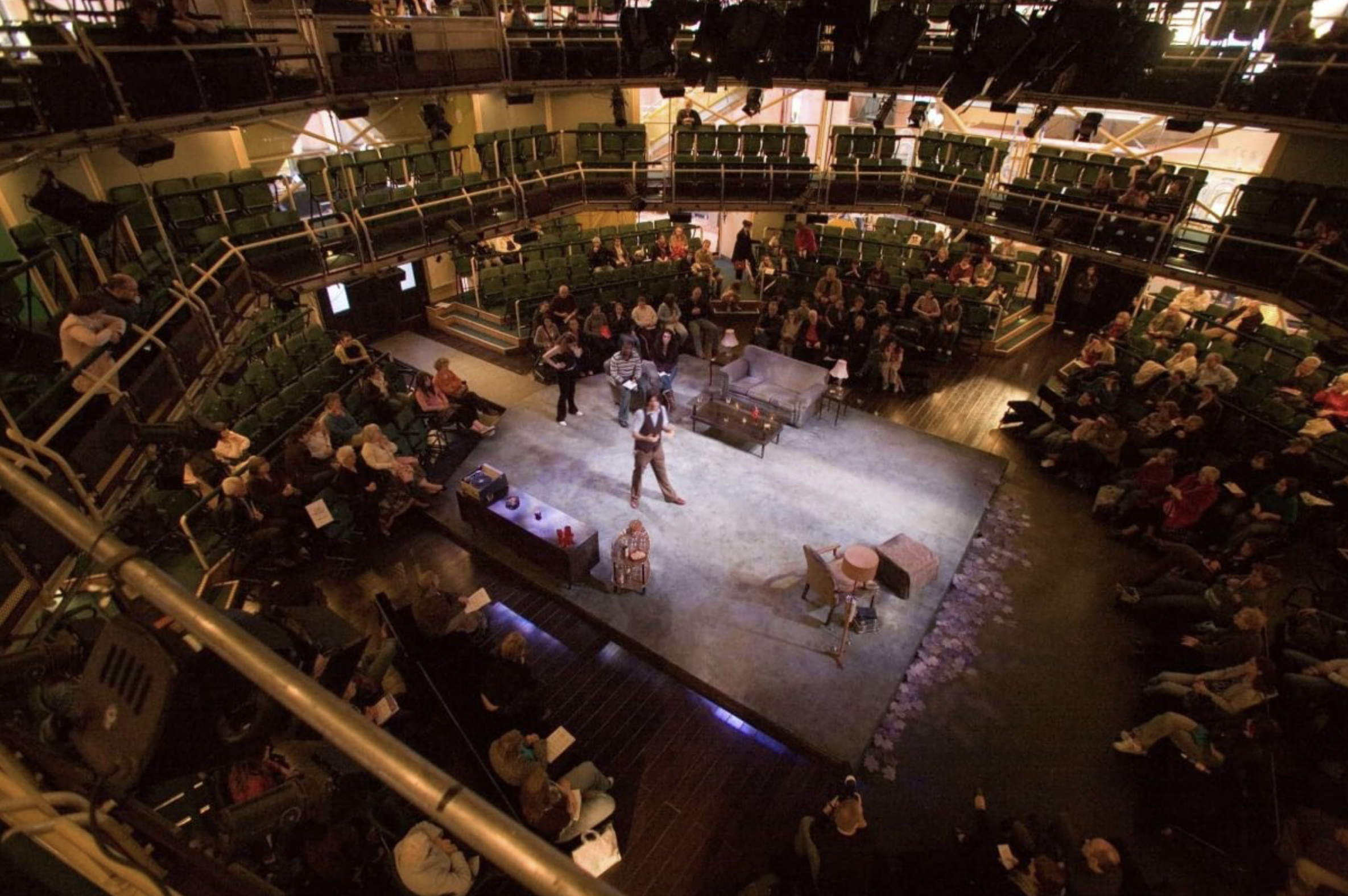
The Royal Exchange is a brilliant space but the seating is very cramped.
They’ve got it the wrong way around. The Royal Exchange is turning it back on me when they are the ones who created the problem in the first place. But as my director friend said on Facebook, it’s a very easy problem to fix. Let’s have an absolutely rock solid unbreakable rule that no single act of anything will ever exceed 75 minutes again. Once they make that decision then they’ll be amazed how easy it is to accommodate it, and how much more enjoyable the theatre experience will be for audiences. The running time of Shed is stopping people from coming, who otherwise might have made the effort. Who on earth does that serve? Is it acceptable to exclude audiences like this when the theatre owes its existence to public subsidy?
I love the Royal Exchange but I need to be confident that I can visit the theatre in future for pleasure, not punishment.
Lastly, I am painfully aware that the writer, Phoebe Eclair-Powell could well be reading my urinary burblings, and I want to emphasise that I bear no animus to her or her play. I’m a writer myself, and as a producer and director I’ve worked with new talent throughout my four decades in the industry. It’s vitally important for the future of British Theatre that people support her work and that of other young writers. I want her to have packed houses. I want the Royal Exchange to keep producing new drama. I also appreciate the vulnerability of writers arriving on the country’s most prestigious stages for the first time. So if Phoebe is reading this, then I sincerely and profoundly hope she is not offended. Although she would rightly be pissed off (so to speak) that I haven’t talked about the content of her play at all.
But that’s kind of the point. I can’t think about it, if I need the loo.
Ultimately, though, this isn’t Ms. Eclair-Powell’s responsibility. I would argue that it is the responsibility of the producing theatre to guide and protect newer talent – who are rightly heady with excitement about their creations – as they move forward in their careers.
I will say this, however. Shed: Exploded View is about domestic abuse – an incredibly important topic – but as any writer who has doubtless researched the subject in great detail will be aware, restricting people’s access to the toilet is, in itself, also a form of coercive control.
It’s such an easy problem to fix.
Can I go to the loo, now, please?
It’s a question that has troubled theatre for centuries
Shed: Exploded View runs at the Royal Exchange Theatre, Manchester until Saturday 2nd March 2024