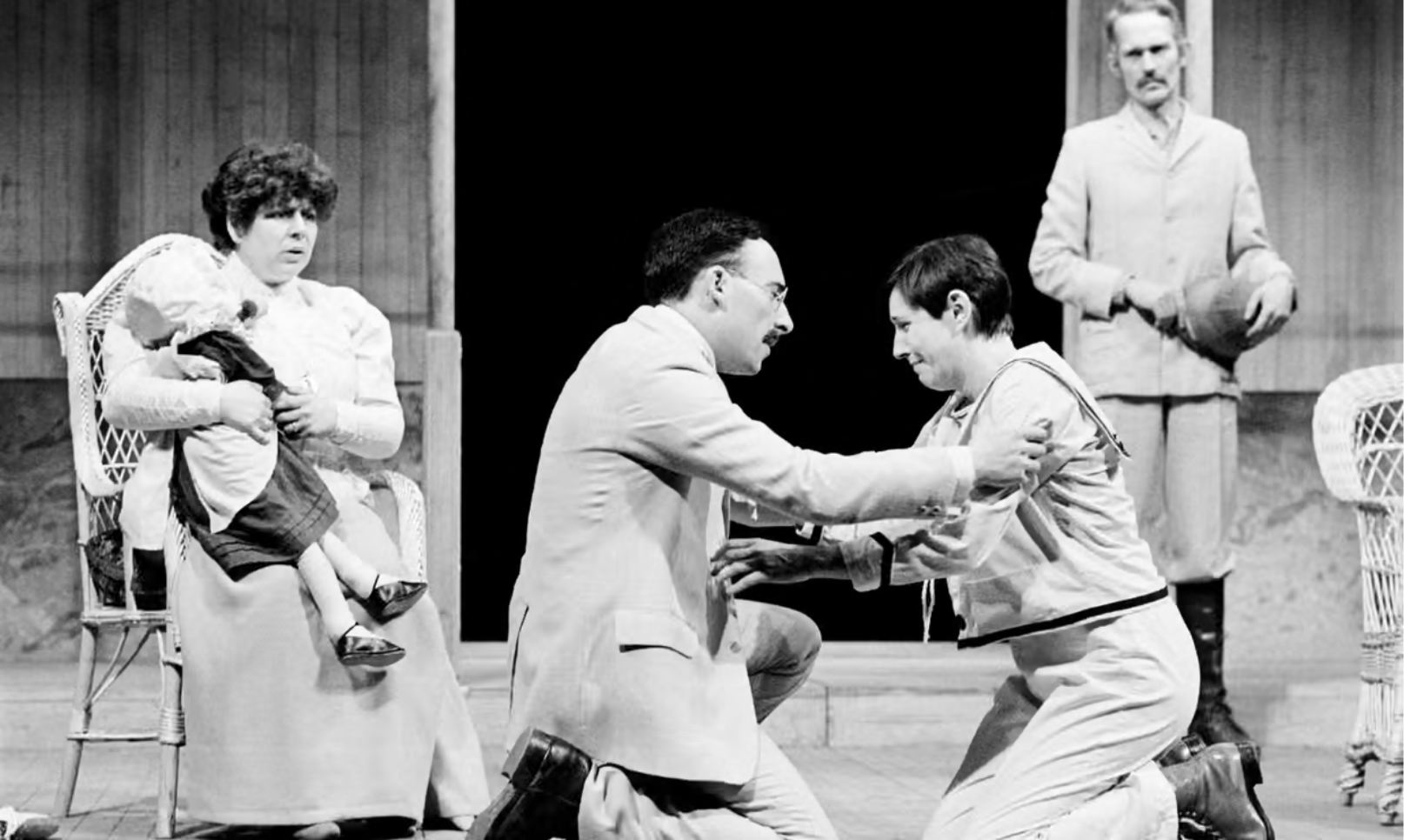
Caryl Churchill’s landmark play Cloud 9 has a special place in my heart. First performed in 1979, I had the great privilege of directing a student production of it while I was at Manchester University in 1981 as part of Manchester Umbrella Theatre Company’s offering to the Edinburgh Festival that summer 45 long years ago. I remember it as a very happy production and one of which I was very proud… perhaps the first time I really got to grips with a mature sense of what it meant to be a theatre director (even though I’d already directed a fair bit by then). And of course it was about sex and gender and there’s hardly anything a 21 year old likes to wang on about more than that.
I haven’t seen or read the play since.
So it was that I found myself feeling both nervous and emotional about watching a preview of the National Theatre’s latest revival of Cloud 9 last Friday night. Aside from all the youthful memories it was triggering, I had an uneasy feeling that it might just be a bit crap. Not the production… but it was very much a play of its time, and nothing dates like yesterday’s contemporary and biting relevance.
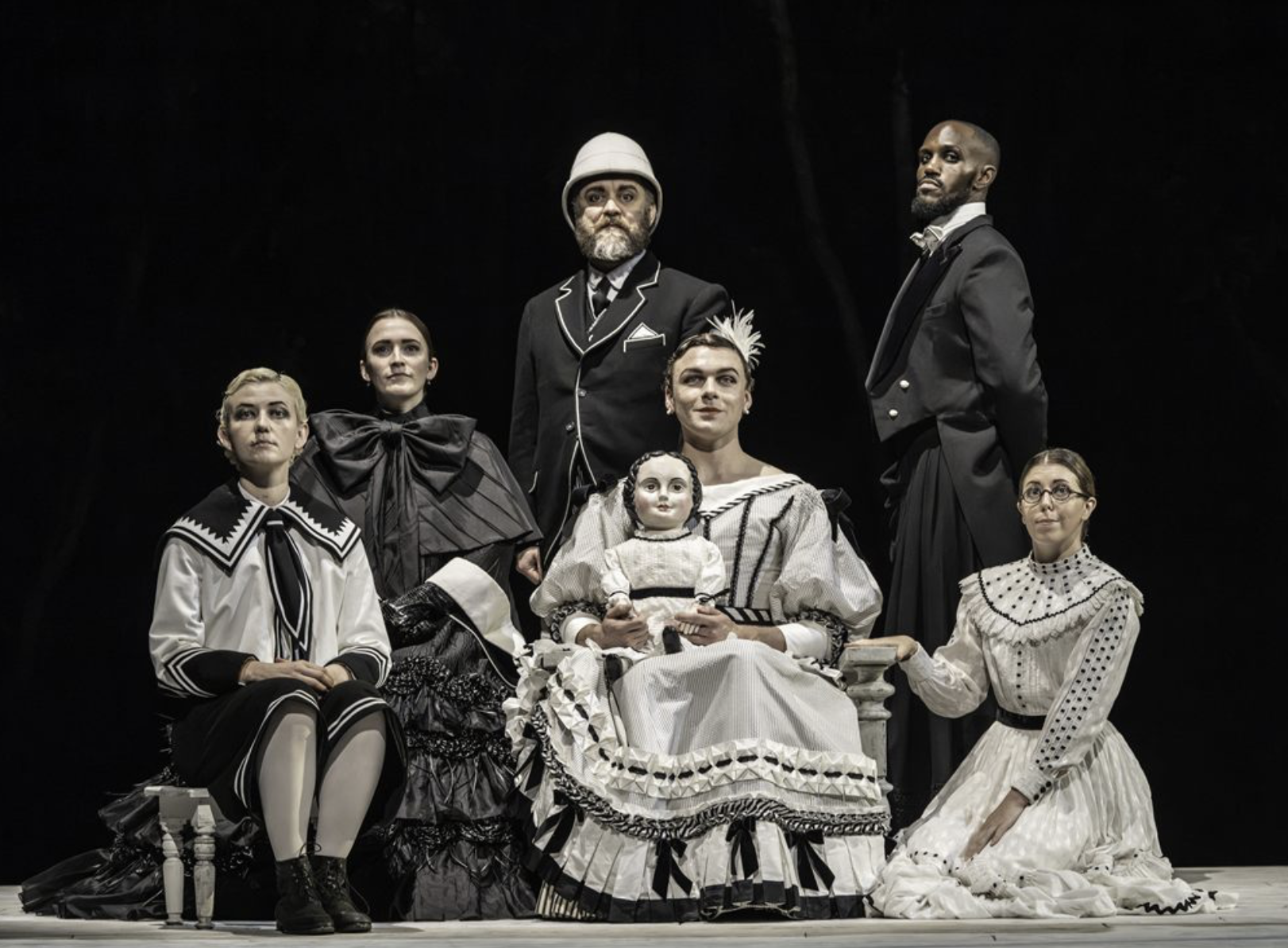
Well, on the plus side it is undeniably a hugely enjoyable evening and the NT cast, including Sam Troughton and Charlotte Ritchie as its best known members, are clearly having a great time too. There are some nice design ideas which I won’t spoil here – and a clear thesis is laid out by director Dominic Cooke. Without going into too much detail I thought the second half, set in 1979 (but with the characters ingeniously having only aged 25 years) was the more successful of the two. I struggled a bit with the first act set a hundred years earlier in Victorian Colonial Africa. Cooke has gone for a pantomime style of posed, monochrome, ‘out-front’ Victorian melodramatic farce. The first half of Cloud 9 IS farce-like – that’s beyond dispute – but my (admittedly distant) memory of directing it is that there is truth and humanity to be found there too. Indeed, if you eschew any attempt to find the truth of the character’s inner humanity then as a satire on repressed and hypocritical sexuality it doesn’t actually make sense. If a character is repressed you have to know what it is they are repressing. For me there’s a vital layer missing in Act 1 of this production – but having said that, it’s an enjoyable romp that had the audience pissing themselves with laughter. I didn’t have any such quibbles with the ‘modern’ second act, which was nicely played all round.
But has it dated?
Ehm… well… yes and no.
If I sound ambivalent it’s because perhaps it reads differently for someone of my age. It was certainly a ground breaking play of its time (the late 1970s/early 1980s) but those of us working in Theatre in Education, Community Theatre, Agit Prop etc spent an awful lot of those decades taking the piss out of Victorian (sexual) hypocrisy… and talking about our genitalia. So perhaps Act 1 will feel fresh to younger generations (i.e. anyone under 55) in a way it doesn’t to me. Act 2 – set in 1979 – prompts a whole other discussion.
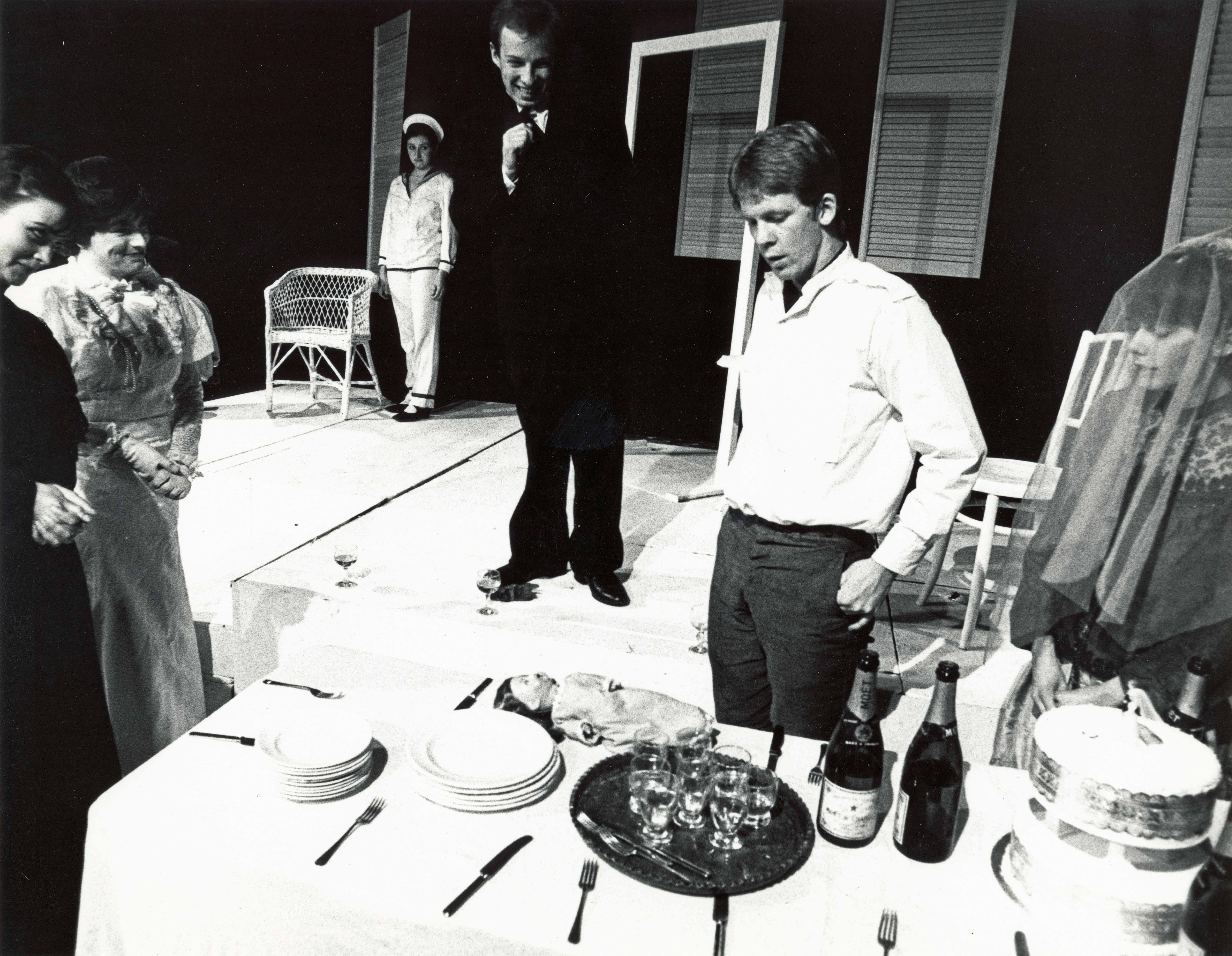
In 1979 – and even in 1981! – 1979 was NOW. In 2026 1979 is most definitely THEN. It is almost as much of a past era as the Victorian age was to the play’s original audiences. The sexual and gender landscapes have changed almost as much. I’ve lost count of which wave of feminism we’re on but I think we’ve moved on at least two. The gay male community has had to contend with the HIV/AIDS epidemic, and AIDS has also had a dramatic impact on sexuality in parts of the same Africa depicted in Act 1. Gay men now have PrEP, and also gay marriage with sexual and cultural implications from both. We have the internet. We have Incels. We have the toxic masculinity of Andrew Tate. We have #MeToo. We have a fiery dialectic between the trans lobby and many lesbians and older feminists. We have Cancel Culture. The characters of Caryl Churchill’s Act 2 aren’t in any way prepared for what is about to hit them.
So, yes, it is dated, not least because in 2026 no writer would include a scene where a prepubescent child sexually propositions an older man. Interestingly, that element of the script survives in the NT revival, however another facet of the original production, not so much. Back in 1979 the part of Joshua, the black African manservant of Act 1, was played by white actor, Tony Rohr. In Caryl Churchill’s foreword to the 1981 published script she writes: ‘There were no black members of the company and this led me to the idea of Joshua being so alienated from himself and so much aspiring to be what white men want him to be that he is played by a white.’ This is an eye-widening sentence to modern eyes, arguing progressive political purpose for blackface/racial appropriation because of Joint Stock’s lack of diversity. At which point, I have to confess to being convinced by the argument myself as a 21-year-old. This sort of reasoning was de rigueur in ‘progressive’ circles as much as conservative ones. The past really is another country. They do things differently there and I’m not planning a trip back any time soon. So, in the NT revival the part of Joshua is played by Eloka Ivo. It would be impossible to do otherwise in 2026, but interestingly that leads to a mismatch in Act 2 when the same actor plays Gerry, Edward’s gay lover, and it feels odd for him not to make any mention of what it was to be black and gay in 1979. It’s hard to imagine that writer of Churchill’s astuteness wouldn’t have written the part differently for an actor of colour. The hierarchy of what is perceived acceptable or otherwise to modern audiences tells a story in itself.
Aside from that, more broadly, what made the Cloud 9 so contemporary in 1979 has now rendered it an incongruously nostalgic (albeit hugely enjoyable) period piece… which is what leaves me craving for Churchill to pick up her quill and give us a new Act 3, set perhaps fifty years later in 2029 but with the characters having aged just ten more years. Cathy, Act 2’s vaguely terrifying 4-year-old, would grow into a 21st century internet-traumatised teen, contemplating gender reassignment, throwing a massive cat amongst Victoria, Lin and Edward’s sexual-cultural pigeons. The faux ‘new man’ Martin has remarried and has a teenage stepson up to his smartphone eyeballs in pornography and online toxic masculinity. Betty is getting arrested at Palestine Action demos.
Of course, it’ll never happen (and before anyone starts, yes, yes, I know it’s not for some 60-something bloke to tell Caryl Churchill what to write!) but there’s a good deal of fun to be had riffing on the numerous possibilities, not least as a salutary reminder that 1979 isn’t just another country, it sometimes feels like another planet.